
Hey my friend! Happy Tuesday! Thank you so much for being here today. In a world that’s goes crazy fast, I appreciate you taking some of your time to read my newsletter and blog.
Have you ever imagined how living on top of the trees, in an immense jungle, could be? I admit I’ve never thought about it until Tamara proposed this article.
Let me tell you: it’s incredibly fascinating.
Make yourself comfortable, this one will make you feel suspended between Earth and Sky.
I wake before dawn.
For years I had imagined what it might mean to sleep in a treehouse. I had built scenarios, anticipated sensations, tried to give shape to that idea suspended between childhood and the desire to escape. I thought I had come close enough.
I hadn’t.
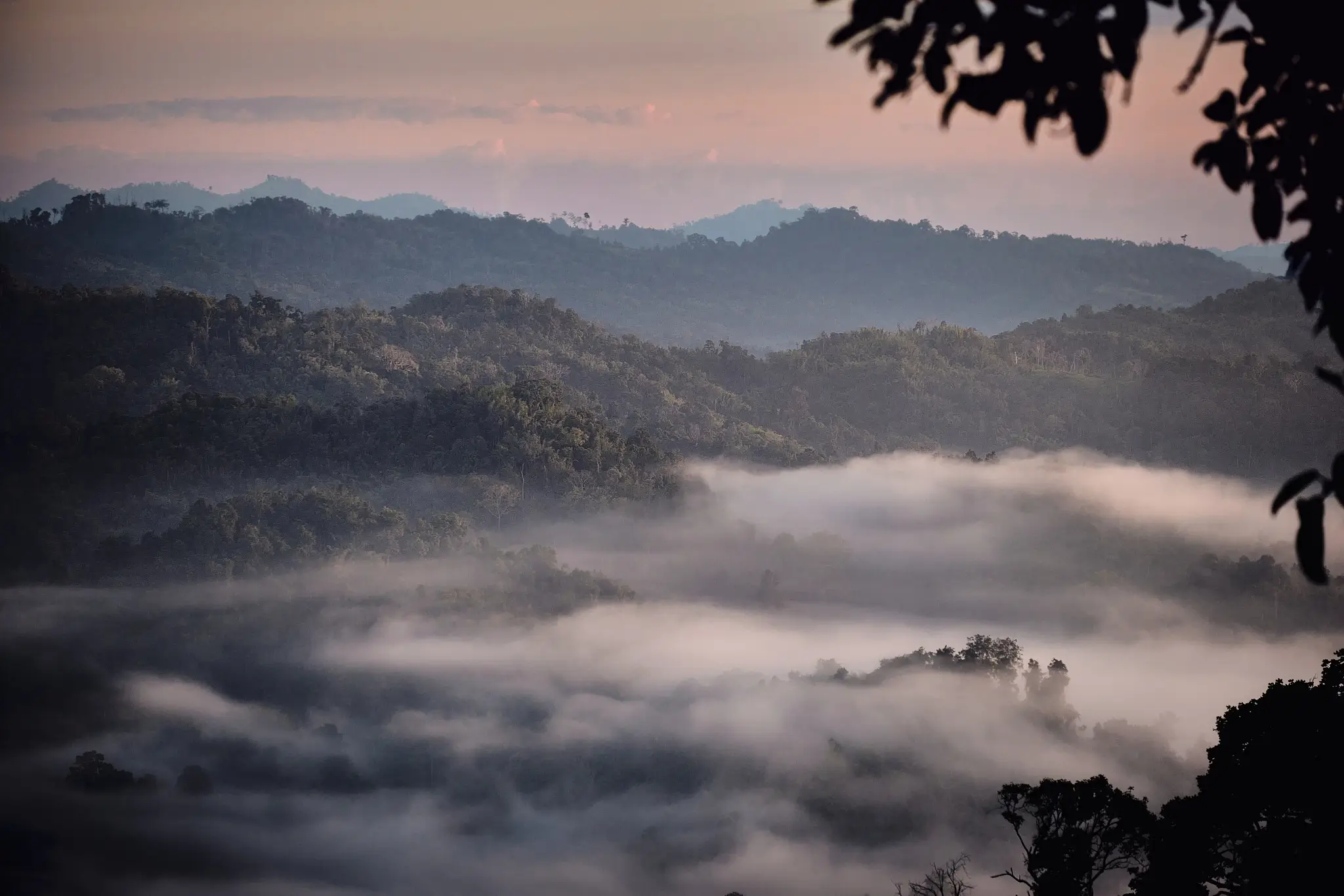
From above, the forest of Nam Kan National Park reveals itself slowly, as if it needs time to grant access.
The sky is pink, crossed by light grey clouds, and below stretches a sea of green that is never the same: it shifts in tone, depth, intention. In the folds of the hills, mist rises, lingering among the trees like a breath refusing to dissipate.
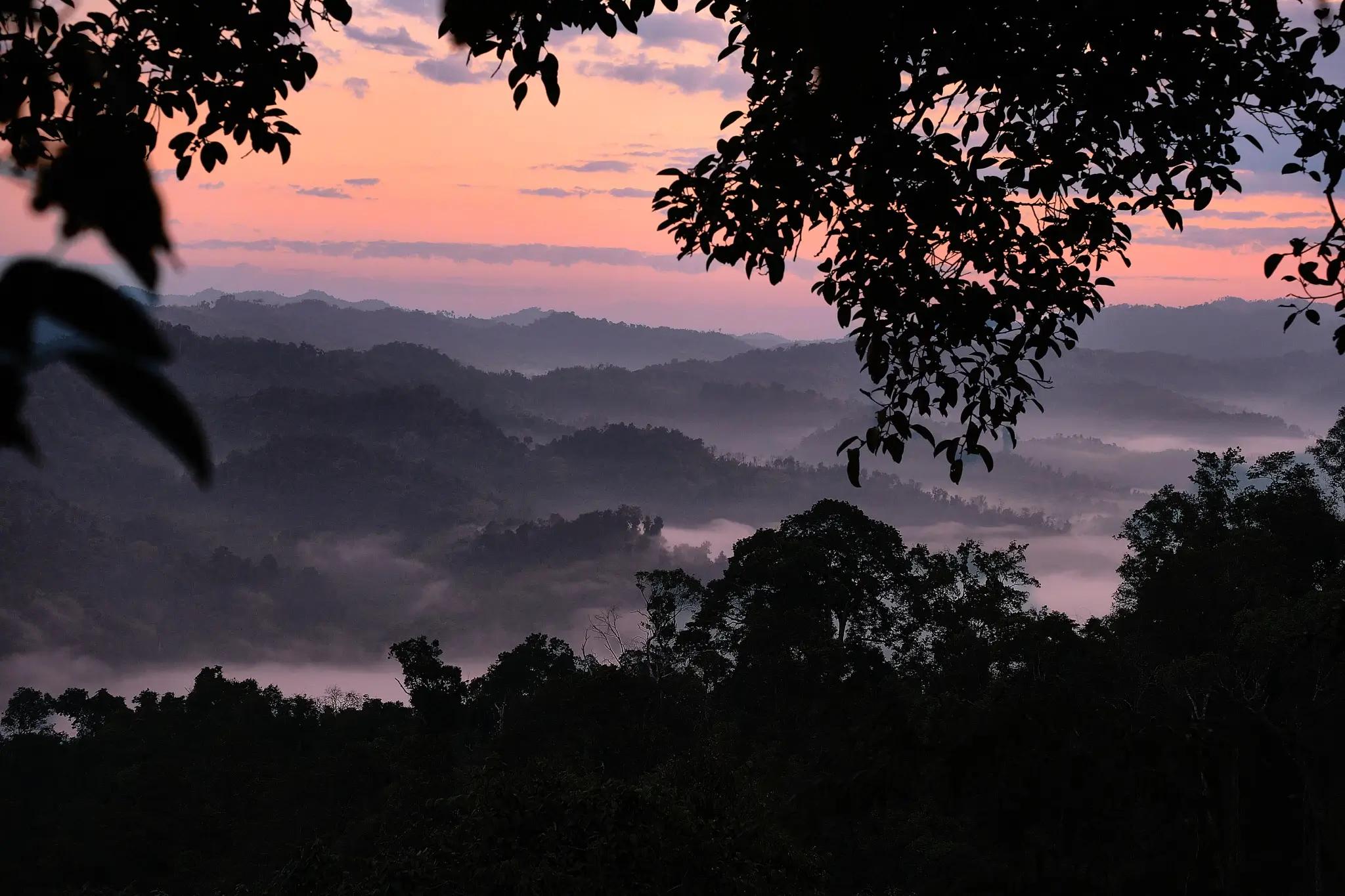
Around me, a living matter: broad fronds, taut lianas, small clusters of orange berries. And then the sounds. A branch snapping cleanly. The constant chirring of insects. The intermittent call of birds.
From up here everything seems still. But it is an illusion. You only need to listen to understand that beneath that surface an entire world is moving, invisible and incessant.
Getting here is already a form of natural selection.
At seven in the morning a tuk-tuk drops us at the bus station in Luang Prabang. The “luxury van” we wait for for hours reveals itself for what it is: a dirty, cramped space, fifteen hours of jolts, reckless overtaking, and shared humanity. We laugh to lighten the fatigue, turning absurdity into story.
In the last hour, the driver slaps his own face to stay awake. Faces grow tense. We are all inside the same trajectory.
We arrive in Ban Houayxay late at night. Just enough time for a taxi, a room, a brief sleep.
The next morning we leave everything unnecessary behind. Our backpacks shrink to the essentials: what truly matters when everything else falls away. At the Gibbon Experience office, a briefing introduces us to a place that allows no distraction. Then the pickup truck, the narrowing road, the village swallowed by jungle.
We have lunch with rice and vegetables and begin walking. Three kilometres that are not distance but transition.
I put on the harness, helmet on my head, check the carabiners. I launch myself.
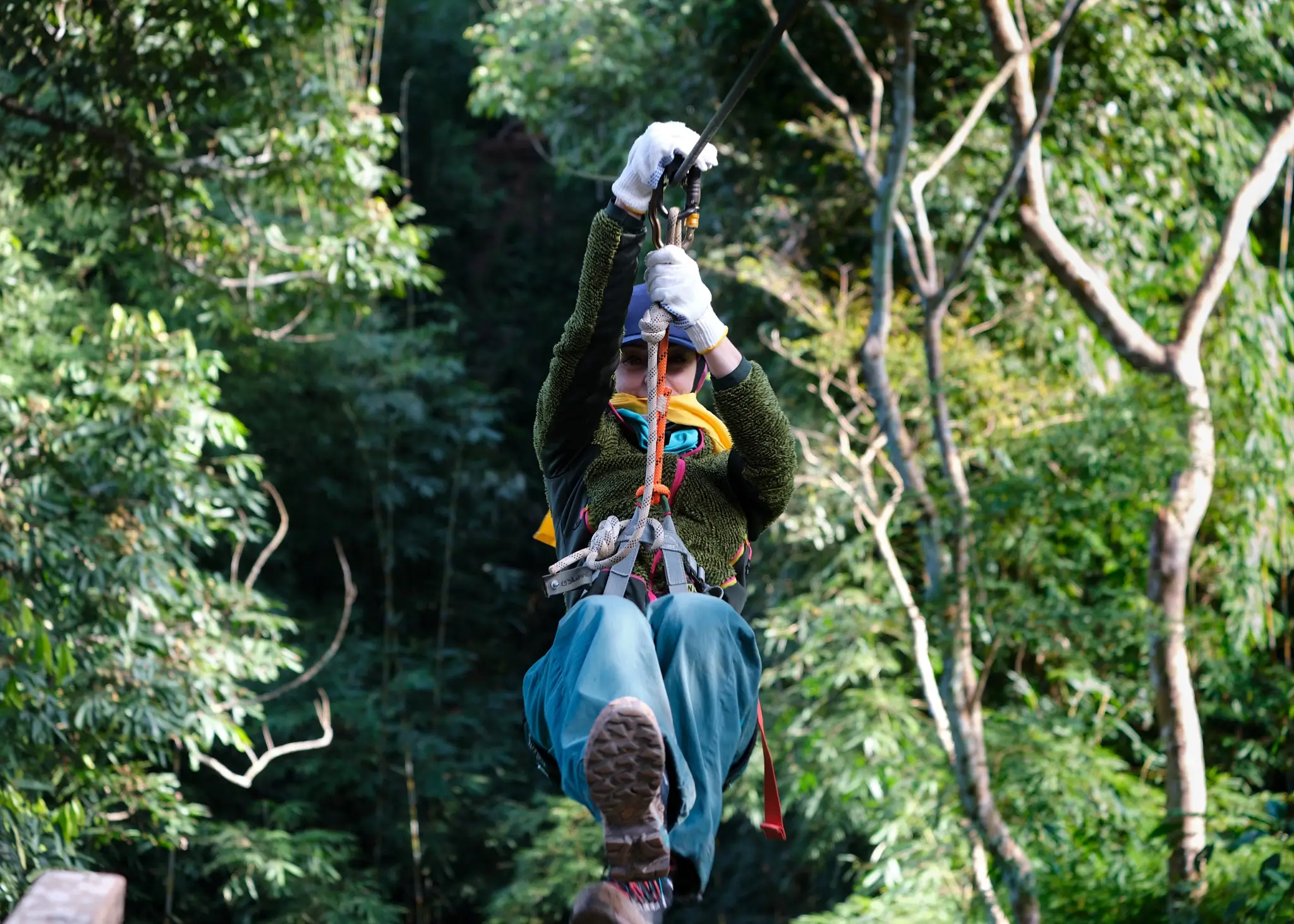
I slide along the cables through shadowed foliage, the wind scraping my skin, green rushing beneath me. I arrive at the treehouse with the pulley whistling.
I feel I belong to another world. To those who have wings.
Here the suspended cables are not only a means of movement: they allow entry into the world of the gibbons. The density of the tropical forest — with trees exceeding forty metres in height — makes sightings from the ground almost impossible. These animals live and move in the highest part of the canopy, invisible to those below. The platforms and zip lines reduce that distance, allowing glimpses of them.
When we finally reach the treehouse — number two — the feeling is not of arrival, but of being granted access.
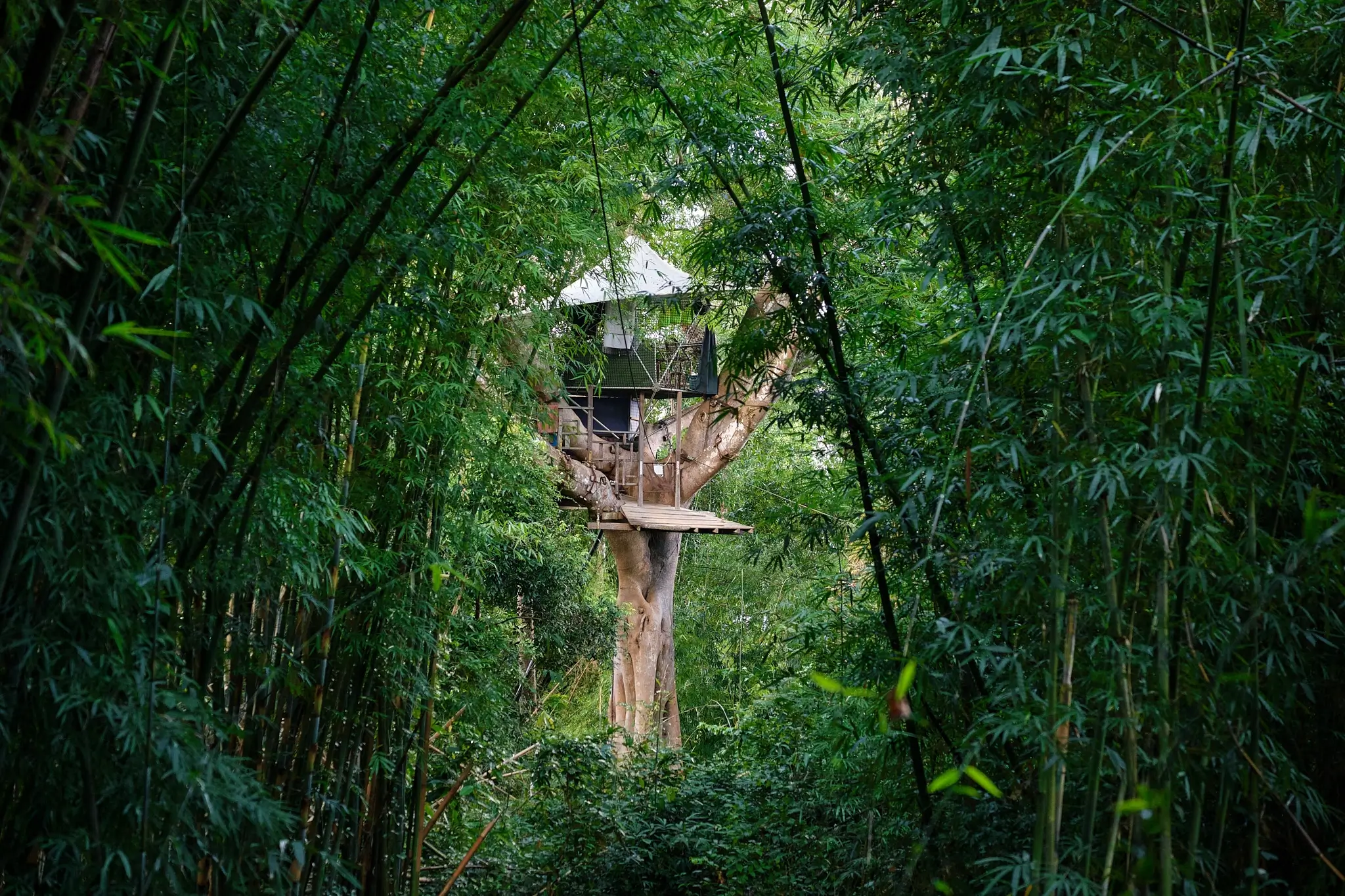
The guide shows us the space, the rules, the limits. He prepares coffee and offers us small, sweet bananas picked nearby. Later he will return with dinner and instructions for the next day.
Meanwhile, we set up the mattress, secure the mosquito net as night thickens all around. The jungle changes its voice. Every slightest sound becomes sharper: a scratch, a creak, perhaps an animal searching for food. There is no fear, only a subtle form of vigilance. As if the body knows it is a guest.
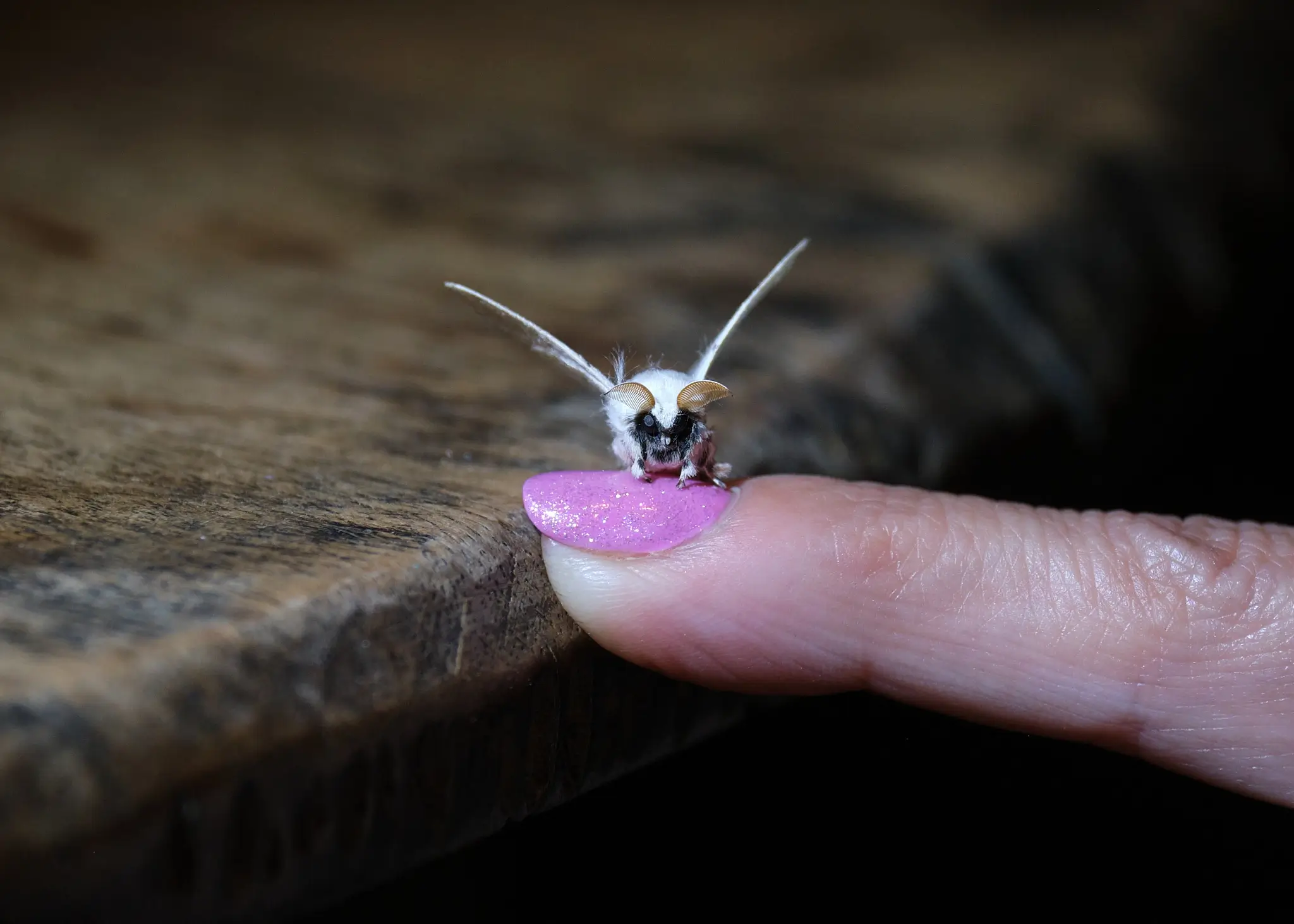
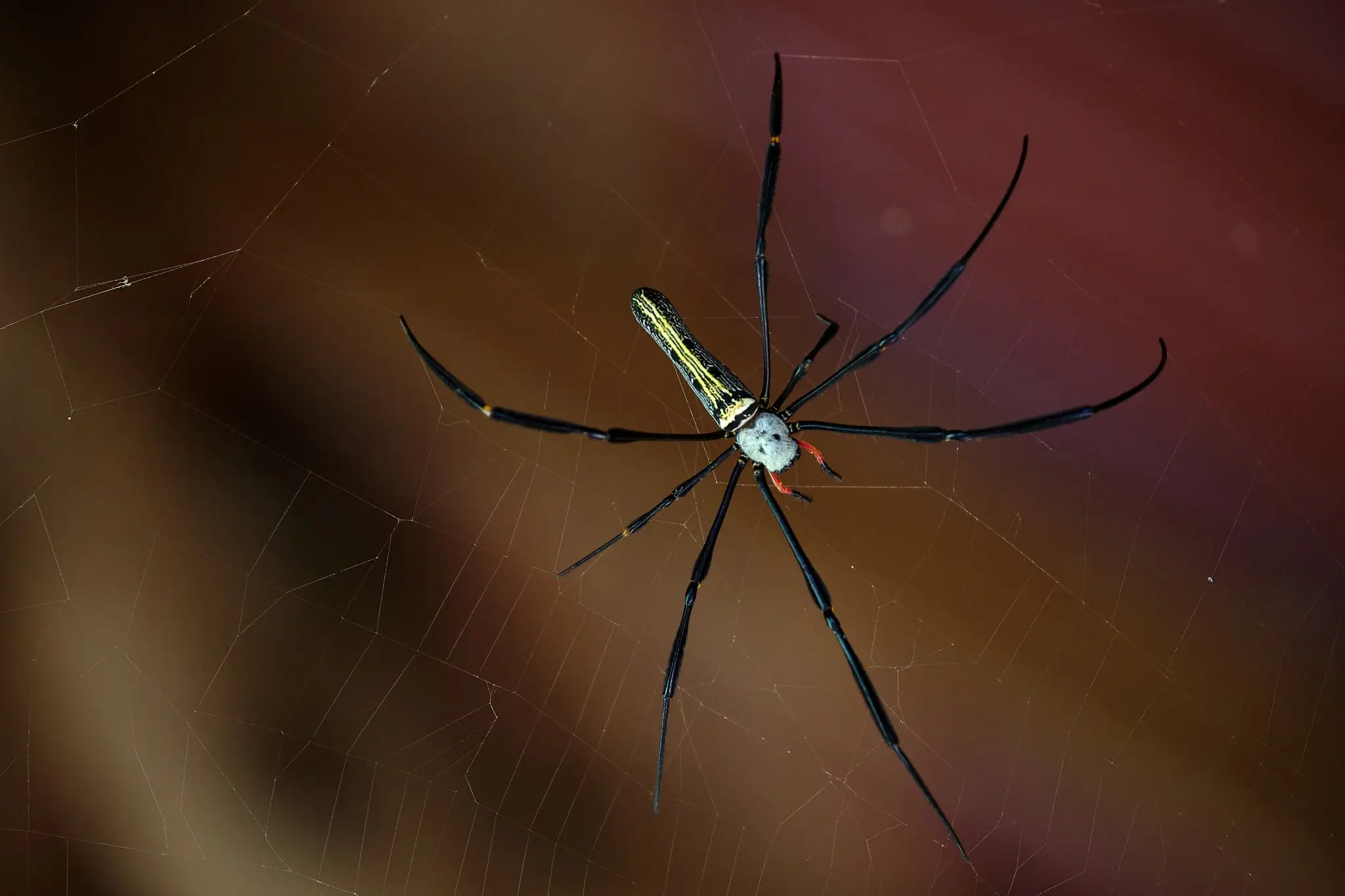
The day is measured in suspended movements.
Along paths and zip lines, we move from platform to platform. The eye learns to search: among branches, across distances, into emptiness.
Here lives the black crested gibbon, one of the most elusive species in Southeast Asia. Arboreal and territorial, it moves through brachiation — swinging from branch to branch — at astonishing speed. Families occupy defined territories and communicate mainly through song: complex, powerful vocalisations, audible from hundreds of metres away, used to mark territory and strengthen pair bonds.
Sexual dimorphism is evident: adult males are black, while females have a lighter, golden-tinged coat. Despite their presence, sightings remain rare. Deforestation and hunting have made them a threatened species, now protected in part thanks to conservation projects like this one.
The last evening we are welcomed in treehouse number four, suspended more than thirty metres above the ground, among the highest treehouses ever built. The light of sunset enters low and sharp, turning everything red. Around the table a temporary community forms: Luke and Grace, between England and Australia; a German father and son.
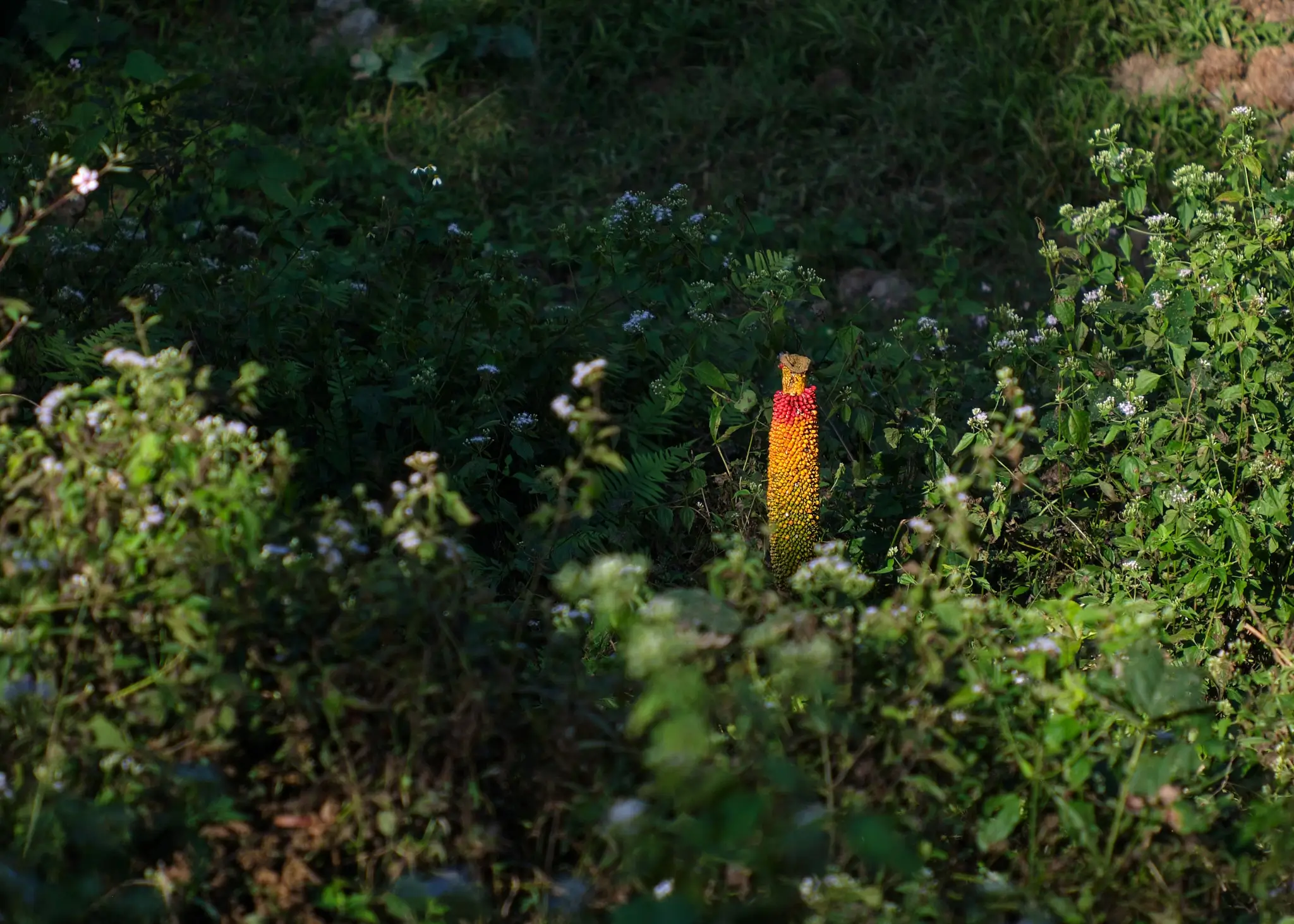
Sticky rice passes from hand to hand, along with chicken, vegetables, and Lao whisky. We toast without formality. Lives are shared that would hardly have met elsewhere.
Here, sharing is not an act. It is a condition.
The return is a crossing through darkness: a trek interrupted by zip lines cutting through the night. The body moves by memory, the gaze surrendering to what it cannot see.
At six in the morning we are on the move again. We climb onto a platform, camera held tightly in my hands, eyes fixed on the horizon, waiting.
Then the gibbons begin to sing.
It is a sound unlike anything familiar: a sequence of modulated calls, both high and low. It begins with isolated notes, almost hesitant, then transforms into an articulated vocalisation, often performed as a duet by the pair.
The result is a chorus that defines space, crosses it, brings it to life.
Gibbons arrive as authentic things do: without warning, without ever fully revealing themselves. They remain distant, suspended above us in an intricate weave of branches and light. I raise my binoculars but see only green. Lorenzo spots one, golden: a female. I follow his directions, but the dense tangle of vegetation makes everything indistinguishable.
I remain there, aware of their presence and of the impossibility of truly seeing them.
We move again, guided by their song. A slow pursuit, respectful, never invasive. Then we return to the treehouse.
We pack our bags. It is time to return to departure logic. The journey continues, as always.
Ban Houayxay slowly brings us back to ordinary scale.
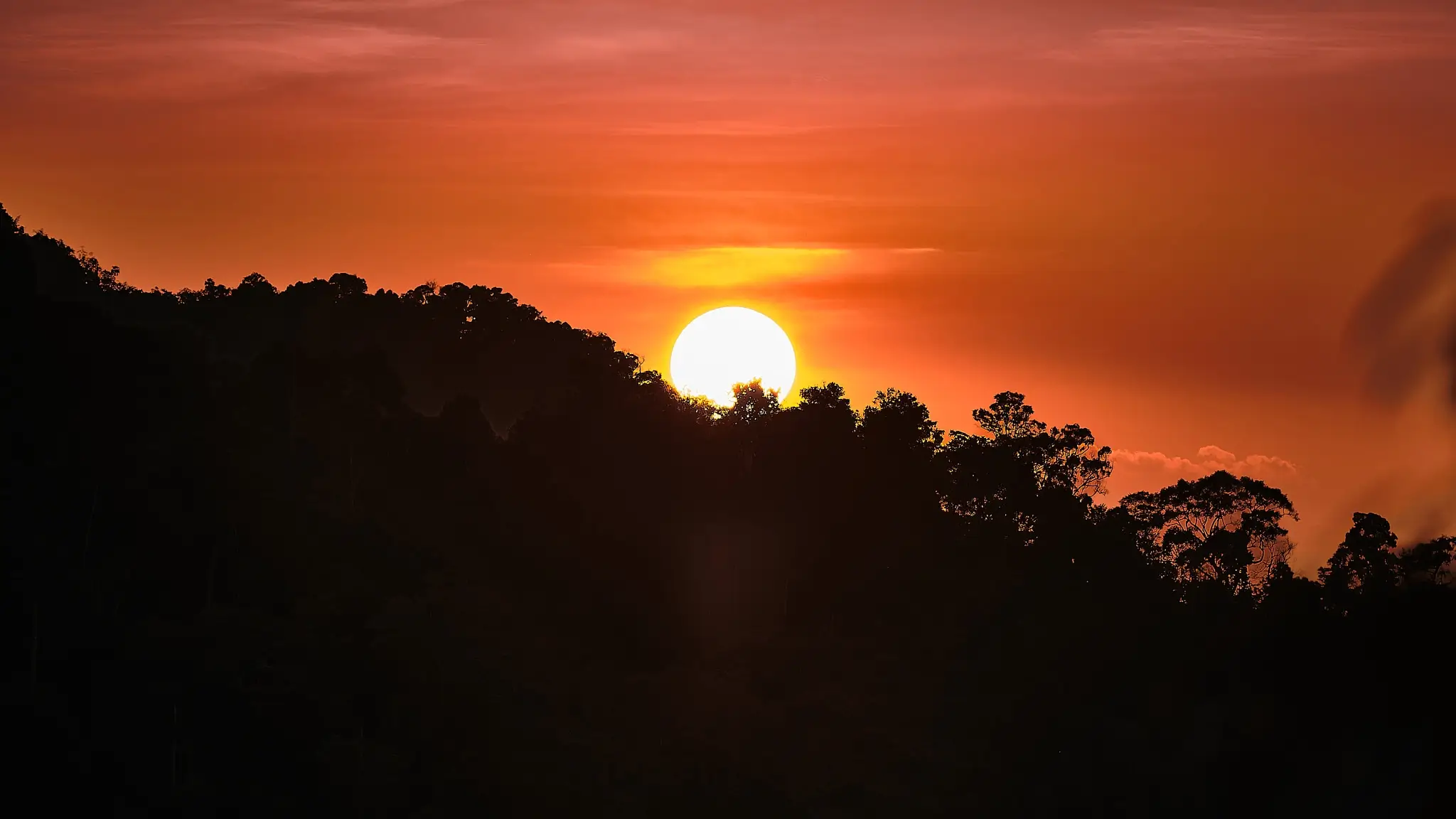
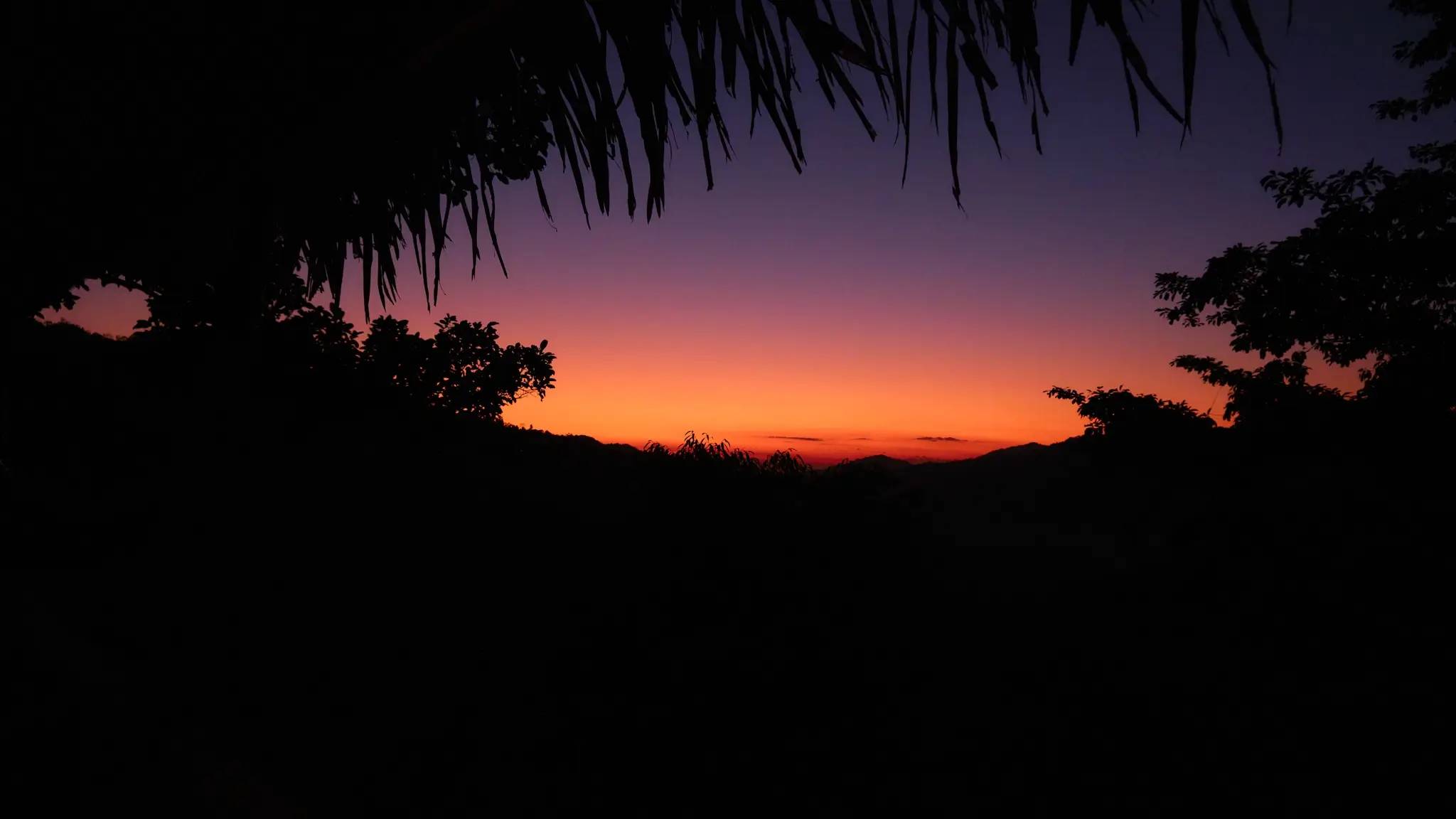
The Mekong flows with a calm that seems indifferent to everything. We walk along the river, then stop for a drink. We meet familiar faces from previous days: the Germans and the Australian couple. The sunset closes the circle, without the need for words.
But something remains suspended, somewhere among the treetops.
Not a precise memory, nor a defined image. Rather, the awareness that there are places where humans are not at the centre, but only passing through.
And that learning to move through them without leaving a trace is perhaps the most authentic form of travel.
Take care and talk soon!