
Happy Tuesday folks! It’s time again for a new article, and as usual it’s for the beautiful series of Tamara‘s adventures around the globe. By the way, did you see how wonderful our little blue rock looks as seen from Artemis II? It’s so fascinating to see our home from up there…
Now, back on Earth, this is the third appointment of Tamara’s trip to Laos — here you can find the first and second articles — and she tells us about an extraordinary creature at the heart of a Laos elephant sanctuary: the Asian elephant, once the true symbol of this incredible country.
So make yourself comfortable and enjoy the read!
In the forest of Sayaboury, the red earth gleams like enamel, marked by the footprints of elephants moving like solemn shadows through the ceaseless rustle of leaves. Entering this space means confronting centuries of memory and learning the art of listening without disturbing.
I still remember Thailand from a few years ago: a trek atop these giants, the adrenaline of feeling their stride beneath me, the thrill of guiding such immense strength. At the time, I did not know what was really happening: many of those animals were former logging workers, forced to carry heavy trunks for years, without space, time, or choice. Today, with that awareness, I understand that the experience—however exciting—was only the tip of an iceberg of suffering and exploitation.
In Sayaboury, the perspective shifts radically.
I am no longer at the center of the spectacle. I step quietly behind the scenes, attuning myself to the primordial rhythm of these creatures. I watch them move among trees and clearings with measured grace, and I am captivated by their calm majesty. The slow lift of a trunk, the barely perceptible tremor of their ears, each step sinking into clay—everything becomes language.
Observing them is an exercise in subtraction: becoming smaller, until one can perceive the silent vastness of the world. In the evening, they descend to the lagoon. I watch them immersed in the water, amid splashes that shimmer in the sunlight and ears that ripple like veils in the wind. It is a gentle ritual, a moment of care and rest, and I remain on the shore, a quiet witness to a life that pulses slowly.
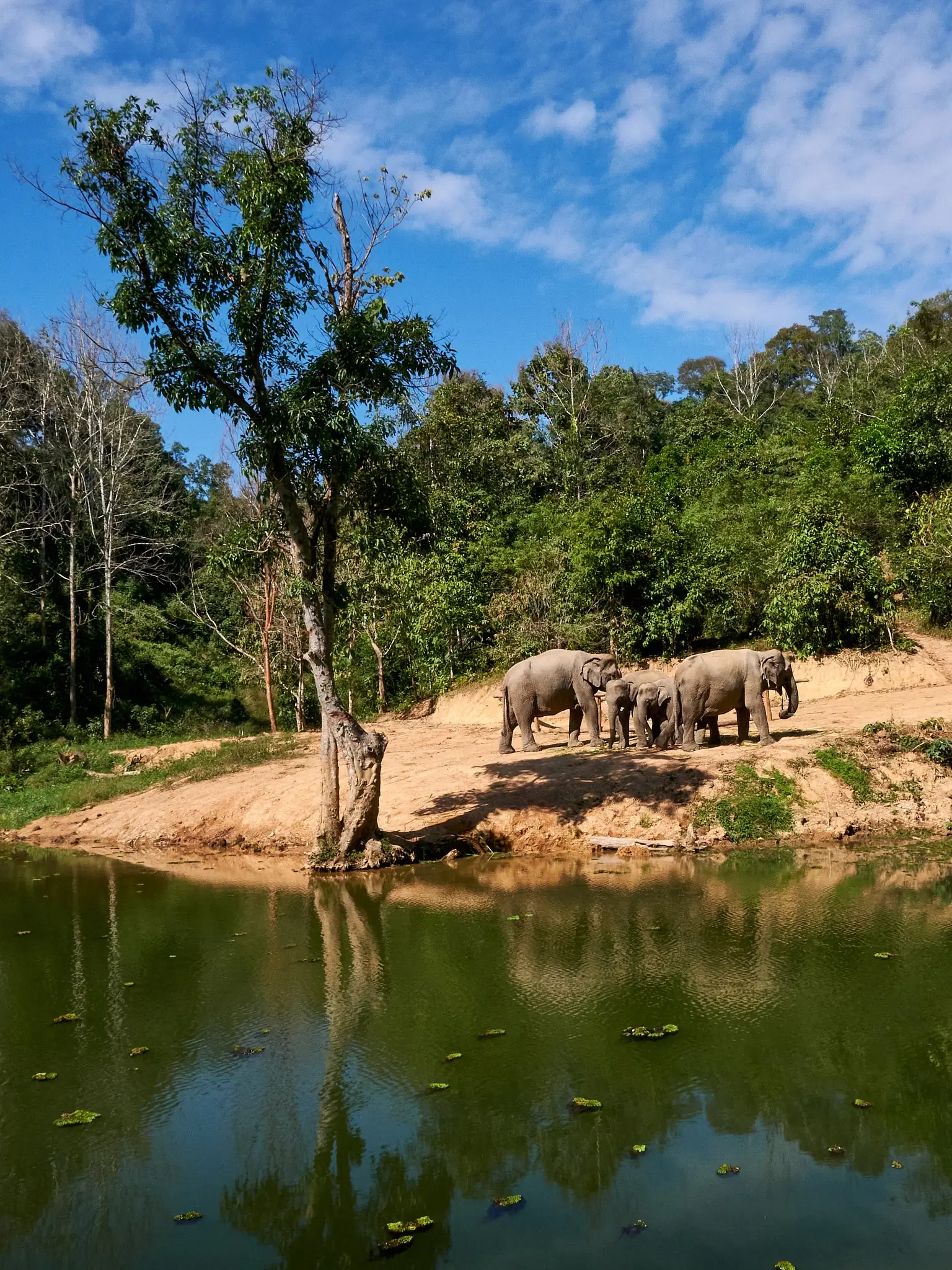
The pachyderms protected by the center are extraordinary.
Some were born in captivity, others bear the marks of years of forced labor in logging or tourism. Within each of them, experience and complex relationships intertwine.
Contrary to its ancient name, once celebrated as the “Land of a Million Elephants,” Laos today shelters only a few hundred wild individuals, confined to increasingly restricted areas. Their disappearance is not the result of a single cause, but of a slow accumulation of pressures.
The jungle, once continuous, has fragmented under the weight of roads, plantations, and settlements, forcing elephants out of their natural corridors and into human territories. This is where conflict arises: fields destroyed, crops lost, and a fragile coexistence strained by necessity.
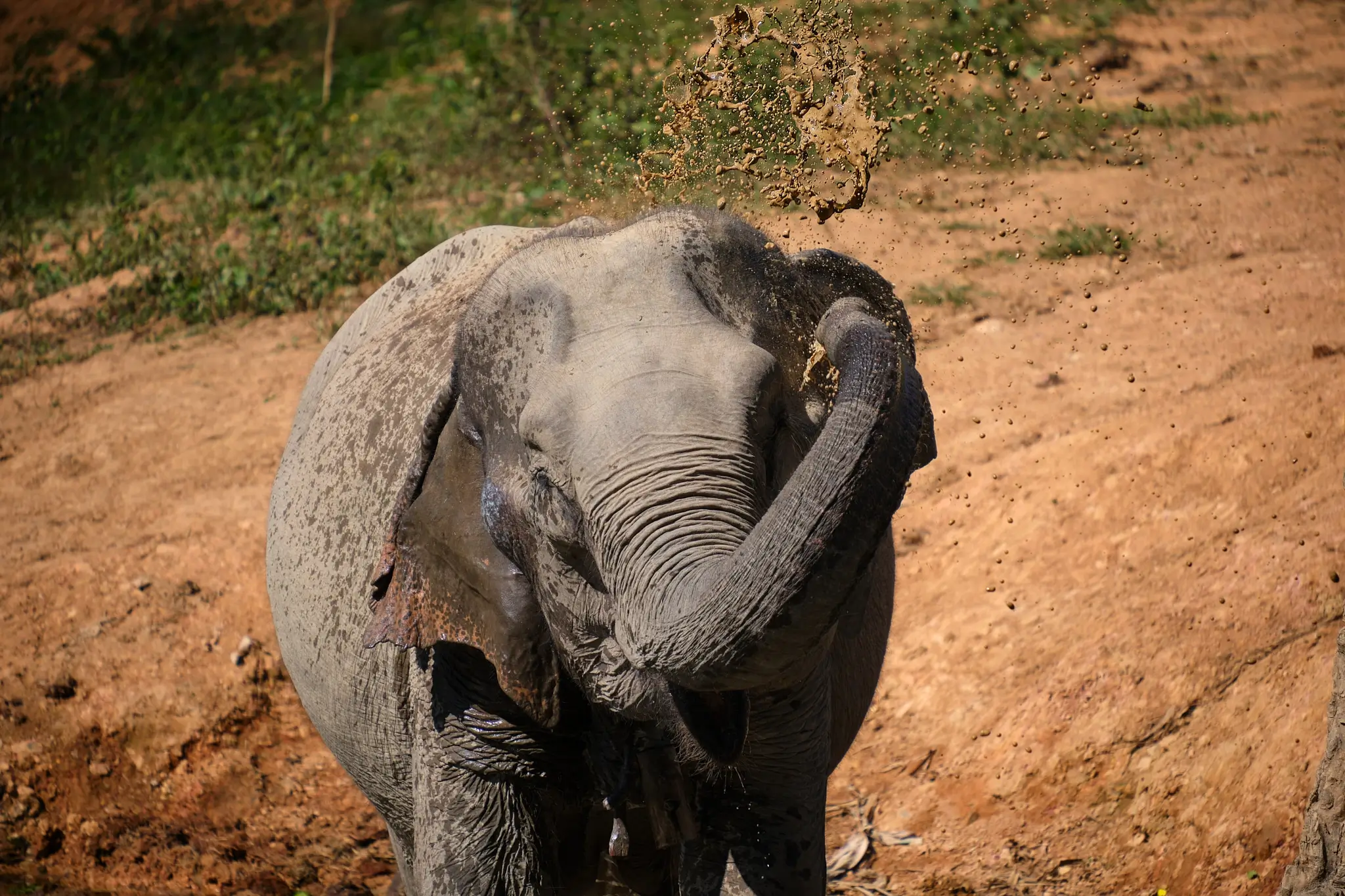
Even domestic elephants reveal a less visible but equally critical fragility.
Their reproduction is slow—nearly two years of gestation and up to five years of caring for a calf—a timeline incompatible with the economic needs of the families who depend on them. For this reason, owners often choose not to breed females, avoiding keeping them inactive for so long.
This is compounded by complex management: enormous quantities of food, constant water, continuous care. When these conditions are lacking, work becomes exploitation, and the body bears its marks.
Thus, between shrinking habitats, economies that cannot afford to wait, and an increasingly precarious balance between humans and nature, the survival of the Asian elephant in Laos hangs by a thread. Every choice weighs as heavily as a step in the mud.
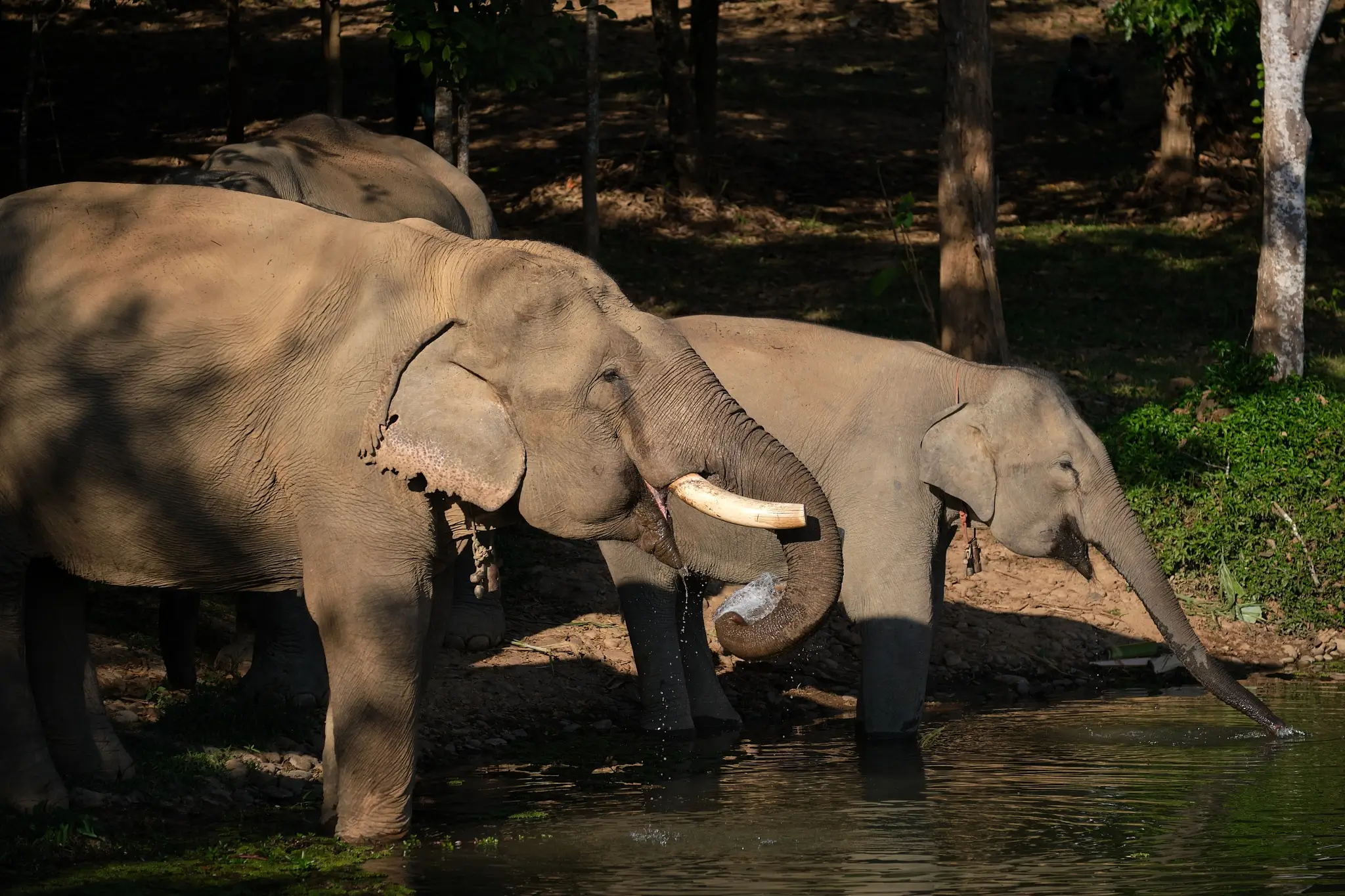
Within this delicate web stands the mahout: guardian, guide, quiet companion.
He walks beside the animal, reading every breath, every variation, every subtle movement of trunk or ear. There are no shouted commands, only a patient trust built day after day.
Without him, the giant—unaware of human boundaries—would wander into fields where food is easy to find. But those crops are often the only resource for those who cultivate them: months of labor, a family’s sustenance, sometimes an entire year contained within a few plots of land. When all of this is destroyed, the reaction is inevitable, and at times brutal.
The mahout thus becomes a living threshold between different forms of survival. Together, they create a unique rhythm, almost poetic, safeguarding stories of respect and symbiosis.
Three days at the ECC center reshape one’s perspective. This is not about watching performances, but about being guided by those who intimately understand these animals: biologists, veterinarians, mahouts, and field staff. It is a living form of learning, revealing Elephas maximus as architectures of memory, relationship, and landscape.
Females form family groups led by a matriarch, a repository of essential knowledge such as migration routes and water sources, while adult males tend to lead more solitary lives. They communicate through infrasound capable of traveling kilometers through ground and air, while the trunk—with its thousands of muscles—becomes nose, hand, and communication tool.
They spend up to sixteen hours a day feeding, consuming hundreds of kilograms of vegetation and moving constantly. In this endless wandering, they become unconscious engineers of the ecosystem: opening paths, dispersing seeds, maintaining biodiversity. Yet this strength is paired with extreme vulnerability: a gestation lasting nearly two years, slow growth, prolonged maternal dependence. Every birth is rare, every loss significant.
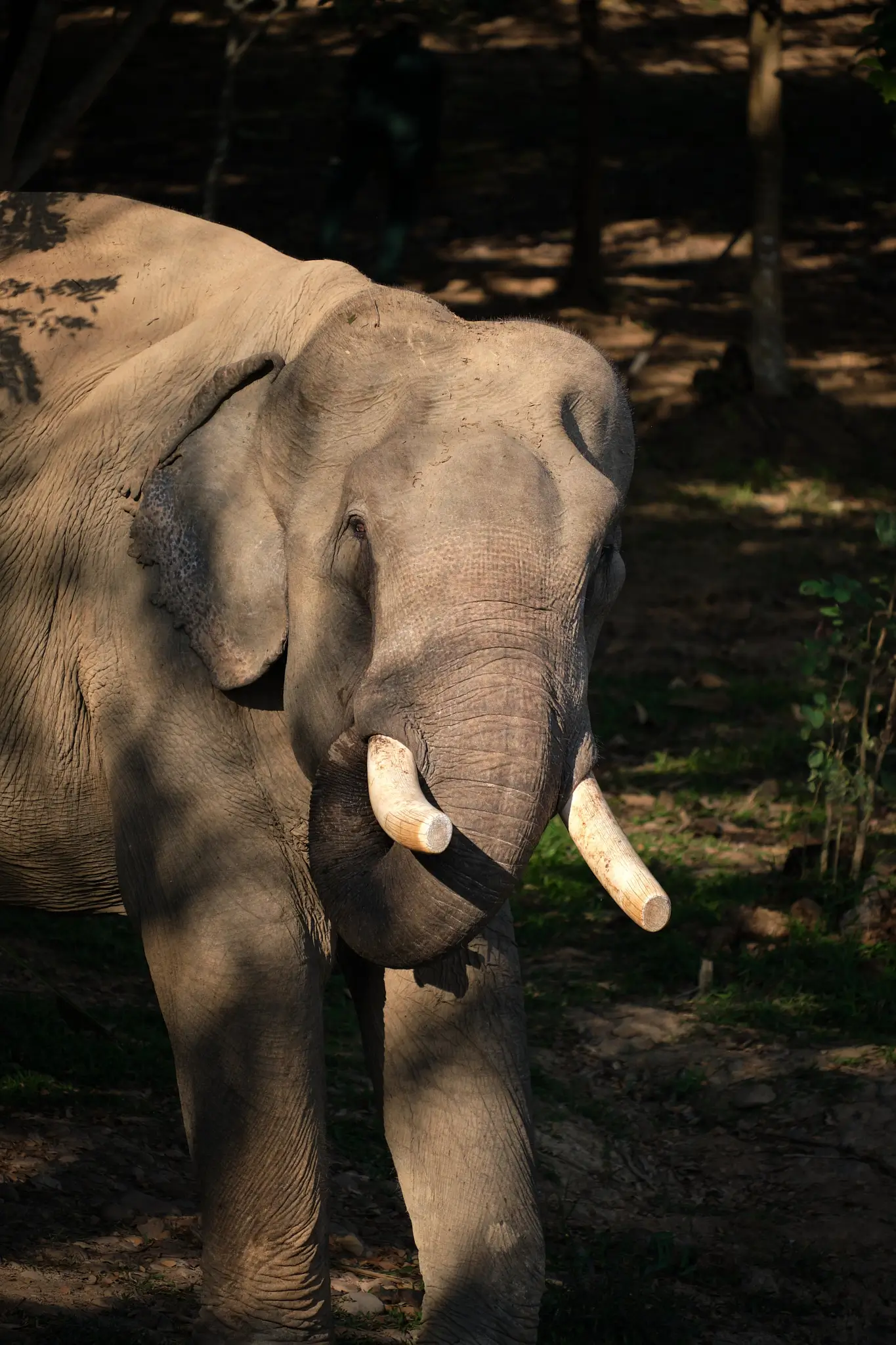
Elephants also possess remarkable emotional intelligence.
They recognize themselves in mirrors, remember individuals after years of separation, and display behaviors akin to mourning, lingering beside the remains of their kind.
Memory thus becomes continuity: an invisible thread linking past and present, like sky and water in the lagoon that, at sunset, merge into a single expanse.
I glide by kayak across that glassy surface, washed in orange and pink, where lotus flowers emerge like delicate brushstrokes suspended in a boundless painting. Each stroke of the paddle carves incandescent filaments, and splashes burst into fleeting sparks.
This is how I take leave of this place, trying to decipher a silent language. In the smallest gestures—a probing trunk, a trembling ear, a hesitation in a step—an ancient awareness surfaces, inviting us to rethink our place in the world, between natural history and human responsibility.
Take care and talk soon!